

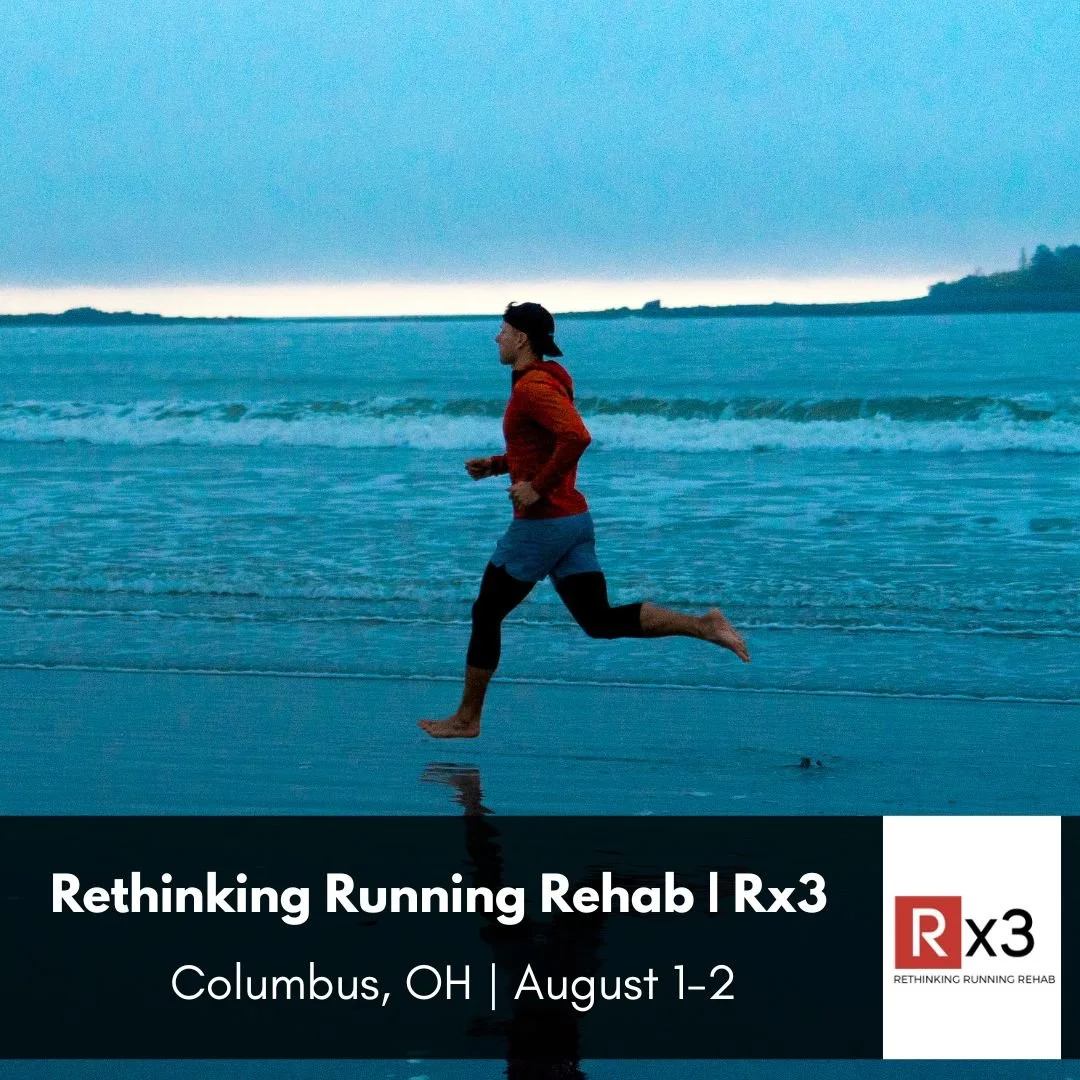
Rethinking Running Rehab | Rx3 (Columbus)
A Two-Day Immersion in the Science and Strategy of Running Injuries
When: August 1-2, 2026
Where: Peak Human Performance - Columbus, OH
For: Coaches, Trainers, Clinicians
Running is one of the most fundamental human activities, yet running injuries remain among the most common and persistent problems in sports medicine. Despite decades of research and advances in the science of training, many clinicians still rely on outdated models of assessment and rehabilitation when treating runners.
Rethinking Running Rehab (Rx3) is a two-day immersion designed to challenge those assumptions and provide practitioners with a modern, systems-based framework for understanding and treating running injuries.
Led by Dr. Beau Beard, this course bridges the gap between emerging research and real-world clinical application. Participants will explore the underlying drivers of running injuries—including the often-underestimated roles of aerobic capacity, training load, and movement strategy—and learn how these factors interact with biomechanics and tissue capacity.
Rather than focusing solely on isolated tissues or “perfect” gait mechanics, Rx3 teaches clinicians how to evaluate the runner as a dynamic system. Through movement analysis, breathing assessment, functional testing, and clinical reasoning, participants learn to identify the true contributors to injury and performance limitations.
Throughout the seminar, Dr. Beard presents a structured approach to evaluating the runner—from initial examination and differential diagnosis to rehabilitation strategies and return-to-running criteria. Case studies and hands-on application help clinicians translate these concepts into practical tools that can immediately improve patient outcomes.
Participants will leave the course with a deeper understanding of why runners get injured, how to assess the athlete beyond pain alone, and how to guide runners back to resilient, efficient movement.
While the course is rooted in running performance and injury rehabilitation, the concepts apply broadly to lower-extremity injuries and endurance athletes across many sports.
Key learning outcomes include:
Understanding why running injuries continue to rise despite advances in sports medicine
Identifying the relationship between aerobic capacity, training load, and injury risk
Conducting effective walking and running gait analysis in the clinic
Performing a needs-based assessment of the injured runner
Applying movement analysis and breathing strategies to rehabilitation
Developing clear return-to-running and performance progression criteria
A Two-Day Immersion in the Science and Strategy of Running Injuries
When: August 1-2, 2026
Where: Peak Human Performance - Columbus, OH
For: Coaches, Trainers, Clinicians
Running is one of the most fundamental human activities, yet running injuries remain among the most common and persistent problems in sports medicine. Despite decades of research and advances in the science of training, many clinicians still rely on outdated models of assessment and rehabilitation when treating runners.
Rethinking Running Rehab (Rx3) is a two-day immersion designed to challenge those assumptions and provide practitioners with a modern, systems-based framework for understanding and treating running injuries.
Led by Dr. Beau Beard, this course bridges the gap between emerging research and real-world clinical application. Participants will explore the underlying drivers of running injuries—including the often-underestimated roles of aerobic capacity, training load, and movement strategy—and learn how these factors interact with biomechanics and tissue capacity.
Rather than focusing solely on isolated tissues or “perfect” gait mechanics, Rx3 teaches clinicians how to evaluate the runner as a dynamic system. Through movement analysis, breathing assessment, functional testing, and clinical reasoning, participants learn to identify the true contributors to injury and performance limitations.
Throughout the seminar, Dr. Beard presents a structured approach to evaluating the runner—from initial examination and differential diagnosis to rehabilitation strategies and return-to-running criteria. Case studies and hands-on application help clinicians translate these concepts into practical tools that can immediately improve patient outcomes.
Participants will leave the course with a deeper understanding of why runners get injured, how to assess the athlete beyond pain alone, and how to guide runners back to resilient, efficient movement.
While the course is rooted in running performance and injury rehabilitation, the concepts apply broadly to lower-extremity injuries and endurance athletes across many sports.
Key learning outcomes include:
Understanding why running injuries continue to rise despite advances in sports medicine
Identifying the relationship between aerobic capacity, training load, and injury risk
Conducting effective walking and running gait analysis in the clinic
Performing a needs-based assessment of the injured runner
Applying movement analysis and breathing strategies to rehabilitation
Developing clear return-to-running and performance progression criteria